

Asking how much an app costs is one of those questions that will have different perspectives and answers, but to help you out, we can tell you the majority of custom app costs are between $50,000 and $400,000 and could be more, depending on how complex it is. Different apps can execute simple tasks or be more complex, like a marketplace or social platform with payment, messaging, and an admin panel.
Before we move forward, let's state the obvious: with the rise of vibe-coding, development changed completely. Now you can build a prototype paying a monthly subscription, and agencies are even faster combining AI with the developers' know-how. Far from making things free, this has moved where the money goes.
Use this guide to understand what an app costs, what increases the price, the three main options for building one, what happens to your budget after launch, and most importantly, what we charge at Designli.
A quick overview to begin with:
- Simple app: $50,000 to $100,000, about 3 to 6 months
- Medium app: $100,000 to $200,000, about 6 to 9 months
- Complex app: $200,000 to $400,000+, about 9 to 18 months
- An MVP at Designli: usually $60,000 to $90,000
- After launch, plan for: hosting and tools, app store fees, third-party services, and ongoing development or support
How Much Does It Cost to Make an App?
If you want to know how much an app costs, you need to be specific. It is the same as asking how much a car costs. Before anyone answers, specify if you are looking for something simple or complex. Are you just looking for a car that takes you from point A to point B, or do you want a car with different types of specs besides the general ones?
Here are the app development cost ranges we use, grouped by complexity. Timelines are based on GoodFirms' 2026 research on app development costs.
| App complexity | Cost | Timeline | Examples |
|---|---|---|---|
| Simple | $50,000 to $100,000 | 3 to 6 months | A booking tool, a notes or to-do app, a simple internal tool for your team |
| Medium | $100,000 to $200,000 | 6 to 9 months | A dating app, a fitness or productivity app, a basic marketplace |
| Complex | $200,000 to $400,000+ | 9 to 18 months | A social network, a large marketplace with payments, an enterprise platform |
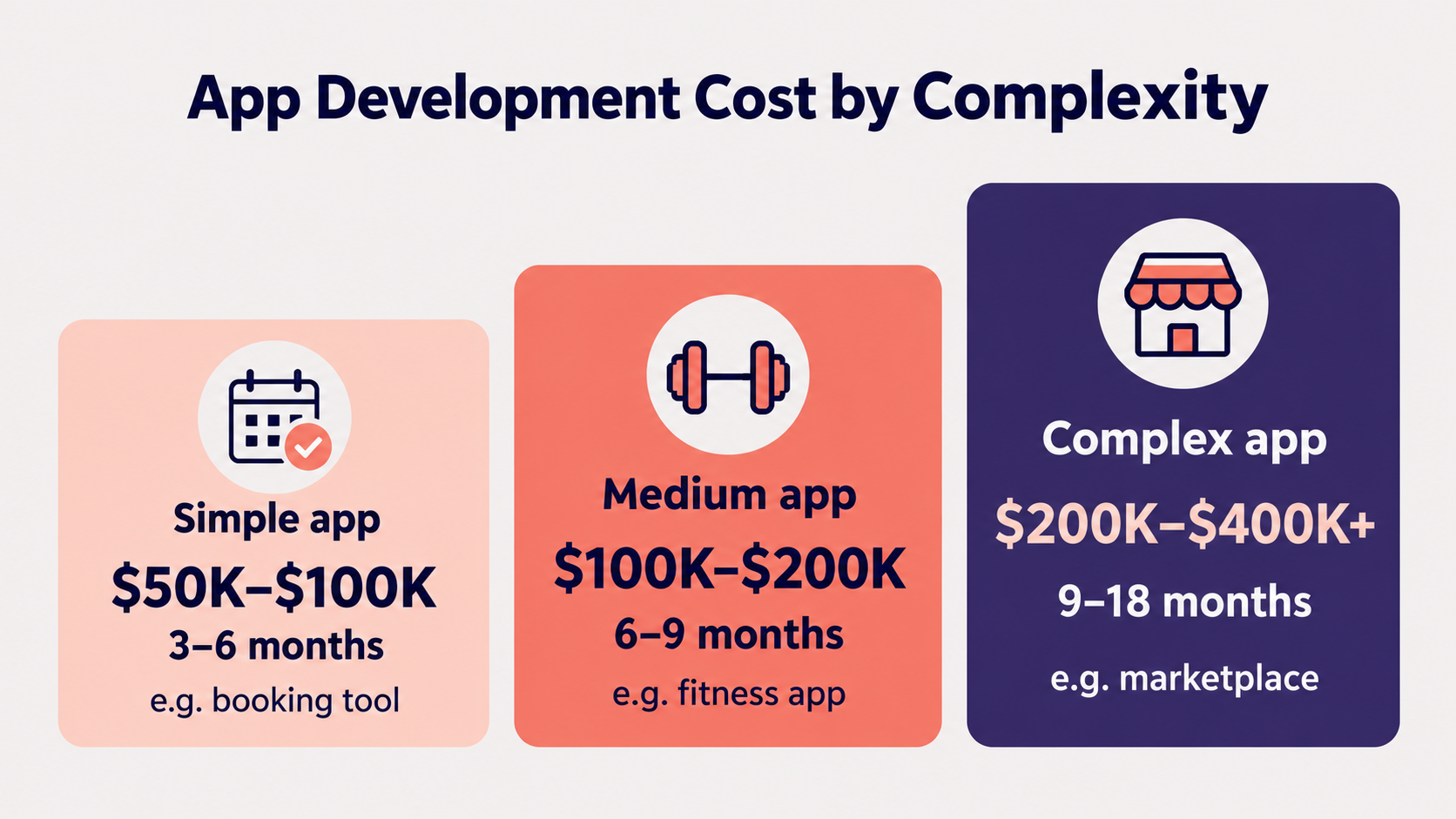
These ranges are for a custom app built by a professional team. If you only need to test whether an idea works, you probably don't need the full app yet. An MVP (minimum viable product) is a first version with just enough features to get real feedback, and it costs less. We go through MVP prices in detail in How Much Does It Cost to Build an MVP?
How Much Does It Cost to Develop an App, by Type
This is not a final or official list of app types; however, it does cover many industries and common ideas.
- Utility apps focus on doing one job at a time; examples can be a calculator or a checklist. The majority of work happens on the phone.
- Data-driven apps work by getting information from another database or source and showing it to the user. The examples you may know are weather, stock prices, or a company's internal reports. To work effectively, they need a backend, making them more of a medium app to develop.
- Social apps are the most known nowadays: apps that let you create profiles, post, follow each other, and send messages. They have feeds and many notifications, so the build usually lands in the medium or complex range.
- Marketplace apps should be able to connect buyers and sellers. In reality you are building two or three apps in one (buyer, seller, and admin) besides payments, so this build is definitely in the medium to complex range.
- Healthcare apps commonly handle sensitive patient information, which translates into extra privacy for the users besides security requirements such as HIPAA in the US. That work pushes up the cost and overall complexity.
- Educational apps can be simple (flashcards or a course player) or complex (live classes, progress tracking, tools for teachers and parents). If the app is for children, privacy rules are stricter, which also adds cost.
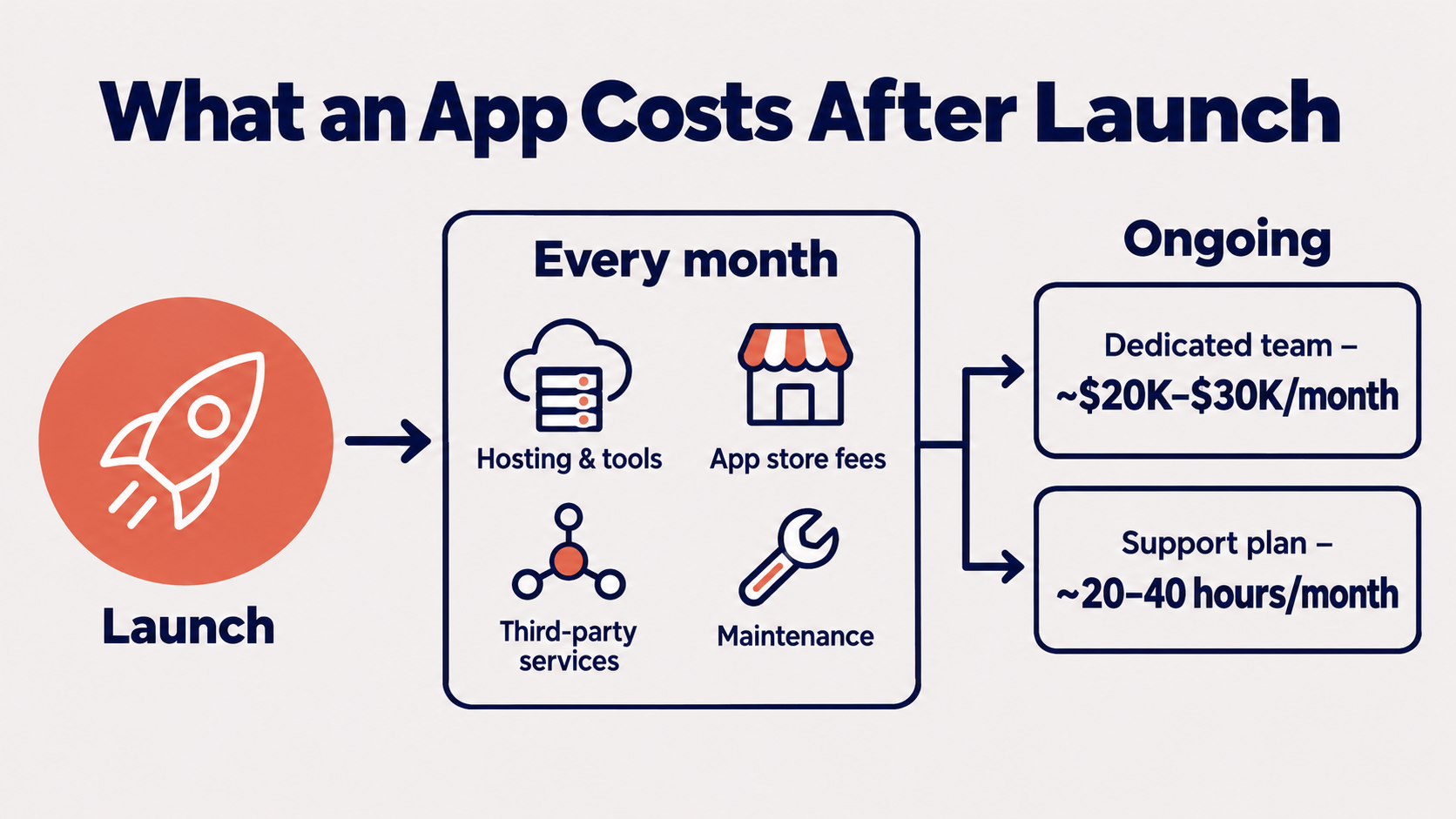
Three Ways to Build Your App
Four years ago, if you wanted to build an app, you could choose between a freelancer, an agency, or an in-house team. AI development now adds a fourth option, which works for solo development or for optimized development from an agency.
Build It Yourself with AI
There are many options out there, but let's use Claude; you can now write working code from well-structured prompts. A Claude subscription costs $20 a month (Pro), $100 a month (Max 5x), and $200 a month (Max 20x). Even with no prior technical background, a non-technical founder can create a decent prototype in weeks.
Prototypes are great to test an idea and showcase your vision to investors through a visual asset. The risk you can prevent is pushing this type of prototype to the market as a fully validated product. At first glance they can seem ready enough; however, the moment unpredictability starts increasing, risk will too. Scalability, security, slowness, all this can happen, and if the app is not properly developed, you will lose time and resources building it again.
Hire a Traditional Agency
A traditional agency works as they have always done, with separate specialists on your project: designers, front-end developers, back-end developers, and testers. A full team with a familiar process, but you pay for everyone involved and every month that runs while the product is developed. According to Clutch's 2026 pricing data, the average app project costs about $90,000 and takes about 11 months.
Work with an AI-Powered Agency
An AI-powered agency could be the best option; by using AI to speed up the building process combined with the experience of the people that get involved, the whole process is optimized. At Designli, AI is used as an enhancer, helping our team complete necessary tasks with excellence at a faster pace, while a senior engineer reviews every code change to ensure security and scalability best practices.
| Option | Cost | Best for | Risk |
|---|---|---|---|
| Build it yourself with AI (e.g. Claude) | $20, $100 or $200 a month | Testing an idea, prototypes, simple internal tools | Security gaps, breaks under real users, costly rebuild |
| Traditional agency | About $90,000 and 11 months on average (Clutch) | Teams that want a conventional process with separate specialist roles | Slow, and the budget grows every month |
| AI-powered agency (Designli) | MVP $60,000 to $90,000; TractionLab $93,450 over 90 days; then about $20,000 to $30,000 a month | Founders who want speed and expert review | Higher upfront cost than doing it yourself |
What Designli Charges
We will get right into it; most MVPs will cost around $60,000 to $90,000 depending on how complex it is and what features go into the first version. If you build through Designli's TractionLab, the price is $93,450 over 90 days, but it covers design, development, and launch.
We will work for you to get a working app with a real user by day 30, with a senior engineer reviewing every code change, and a first paying customer as the goal by day 90. A development process that does match user intent.
If you want to keep working with us from day 91 onwards, you can keep building with a dedicated team for about $20,000 to $30,000 a month, or move to a support plan team to keep your app healthy and working.
You don't have to start with a full build. Where you begin depends on where your product is today:
| Where you are | Where to start | Cost |
|---|---|---|
| You already have a product that needs a review | Impact Week: a one-week audit of your code and UX, with a findings report and a 90-day plan | $1,700, 1 week |
| You're starting from scratch | SolutionLab: a clickable simulation of your product and a plan for your first version | $6,900, 5 days |
| You're ready to build | TractionLab | $93,450 over 90 days |
If you start with the SolutionLab and decide to continue with us for full development, the second SolutionLab payment ($3,450) goes toward the development.
Hosting, tools and other services are paid by you directly, so the accounts, data and code stay in your name. How much they cost depends on how complex your app is.
For more on MVP pricing, see How Much Does It Cost to Build an MVP? For a full walkthrough of every stage, see How We Build: Designli's Full 2026 Development Process, Pricing, and Services.
Platform Choices That Change the Price
Mobile App or Web App
A mobile app will be commonly downloaded from the App Store or Google Play and will be used on your phone. Meanwhile, a web app runs in a browser, on a computer, or on a phone and the user does not have to install anything.
It's no secret that web apps are cheaper to build, mainly because one version works everywhere and you don't need app store approval. Mobile app development cost is higher because mobile apps can add features like a camera, GPS, and push notifications. So basically your decision should be based on those factors; if you have a tight budget, go for a web app; if you need specific features, go for a mobile app. We compare them in more detail in Mobile App vs. Web App.
iOS, Android or Both
If you decide to go mobile, one important decision is choosing where to launch, which should be where your users are. iPhone usage is more common in the US, while Android has more users in many other countries. A good strategy is launching on one platform so you can check adoption from users; if you build on both at the same time, it's riskier. See Launching Your App on iOS or Android for help choosing.
Native or Cross-Platform
It's also very important to understand the difference between a native app and a cross-platform app. A native app is built exclusively for each platform, one for iOS and one for Android, each one in its own language. From a performance and access POV, it's ideal; however, you are paying for two builds. A cross-platform app uses one codebase for both; you can use frameworks like Flutter, which has improved a lot in the past years. For most apps this is a better approach for a lower budget. It all depends once again on the complexity of your app. We go deeper in Should I Choose Cross-Platform or Native for My Mobile App?
Design and Development
Design and development are two different kinds of work, and both show up in your budget.
Design (UX/UI) decides how the app works and how it looks. UX (user experience) is about the flow: what screens exist, what happens when a user taps something, how easy it is to get things done. UI (user interface) is the visual layer: colors, typography, buttons and layout. In a typical app development process, design comes first, often as wireframes and then a clickable prototype, so you can test the idea before anyone writes code. Read more in UI vs. UX: What's the Difference?
Development turns those designs into a working product: the screens users see (front end), the servers and databases behind them (back end), and the connections to outside services.
What drives the cost of each:
- Design: how many screens, how custom the look needs to be, and how many rounds of user testing you want
- Development: how many features, how much happens on the server, how many outside services you connect, and how much security and data protection the app needs
Doing design before development usually saves money. It's much cheaper to change a screen in a prototype than to rewrite a feature that's already built.
Why Pricing per Feature No Longer Makes Sense
A couple of years ago, charging per feature was still very common, with so many hours for an email sign-in or for user management and so on.
But now basic features like a sign-in or an admin list of users can be built quickly with AI. Estimating cost based on hours per feature does not hold up today because the time spent won't showcase the actual value of the creation.
The real outcome here is long-term usability. Will it be secure? Will it hold up through the shift from 50 to 5,000 users? Can you keep adding features without starting over? And most importantly, does it work ideally for your audience? All of these are factors based on experience, not on speed.
That's why at Designli we price around the outcomes we provide. With TractionLab, the objectives are a working app with a real user by day 30 and a first paying customer by day 90.
How AI Changes App Costs
Here's how AI has changed three key things about app costs.
- Building is faster: Accessibility to faster development for first versions of screens, features, and tests is now a reality. This shortens timelines, which lowers the cost of routine work.
- Expert review matters more than ever: Yes, AI writes code fast, but it also makes a lot of mistakes in the process, which are really easy to miss, such as security holes, shortcuts that break at scale, and logic that works in a demo but not in real life. Now you have to ensure you pay for senior engineers that work as a 'human in the loop' to ensure that AI code makes sense.
- AI features have running costs: If you are adding chatbots, summaries, or recommendations through AI, every request costs money. Those fees will keep growing with your app, so plan for them the same way you plan for hosting.
Ongoing Costs After Launch
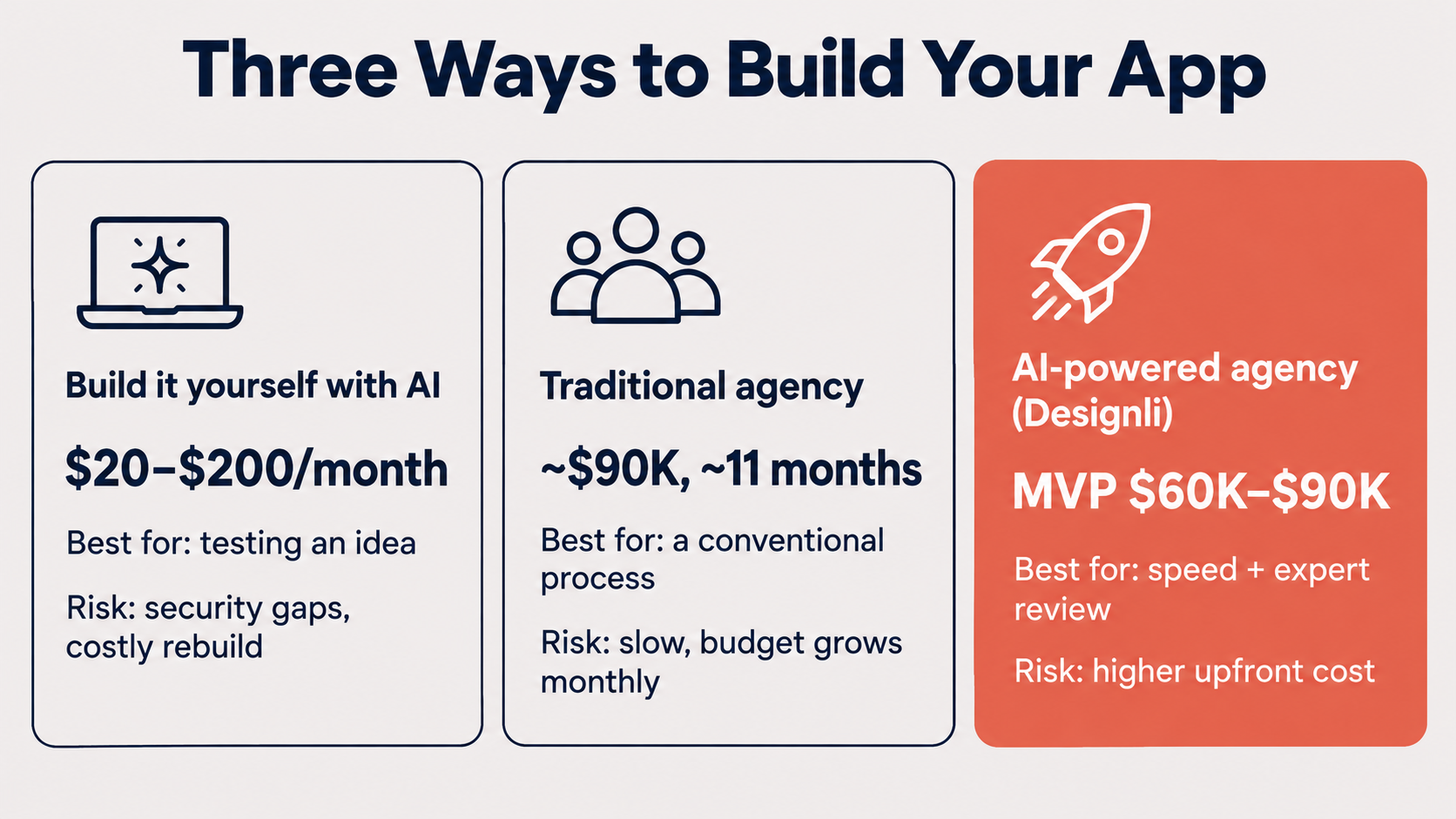
Launch isn't the end of your budget. Plan for these ongoing costs from the start:
- Hosting and tools: Servers, databases, file storage, email services and monitoring. At Designli you pay for these directly so everything stays in your name. The amount depends on how many people use the app and how much data it handles.
- App store fees: Apple charges $99 a year for a developer account, and Google charges a one-time $25 fee. Both also take a commission on in-app purchases and subscriptions, usually between 15% and 30%.
- Third-party services: Payments (Stripe, for example, charges 2.9% plus 30 cents per card payment in the US), messaging, maps, analytics and AI services. Most charge monthly or per use, so the costs grow as your app grows.
- Maintenance: Phones and operating systems update every year, and your app has to keep up. Bugs, security updates and small fixes never fully stop.
- New features: Once real users are in the app, you'll learn what to build next. Most successful apps keep improving long after launch.
At Designli, ongoing work usually takes one of two forms: a dedicated team for about $20,000 to $30,000 a month if you're still adding features, or a support plan of about 20 to 40 hours a month if you mainly need the app kept running smoothly.
Hidden Costs
These are the costs founders most often forget to plan for.
- Privacy policies and compliance: Apple and Google require a privacy policy before they accept your app. A simple app can use a basic one. An app for children, or one that handles health or financial data, needs a much more careful policy and often legal advice.
- Integrations: Connecting to other systems, like a CRM, a bank or an existing database, takes more work than most people expect, especially if the other system is old or poorly documented.
- Legal and business setup: Terms of service, contracts with your development partner, and protecting your intellectual property all take time and money.
- App store review: Apple and Google can reject an app or ask for changes, which adds time before launch.
Why Is App Development So Expensive?
To create a well-developed app, there are multiple steps and actions to achieve greatness. Behind every tap is a server, a database, security, and a connection to outside services, and all of that has to work on many different phones. Actually, building an app takes different skills, combining effective design, development, testing, and product strategy, to name some.
We've mentioned how AI can work as an enhancer in your workflow; it will remove long, repetitive tasks and optimize them, but it won't substitute the knowledge of designers, developers, QAs, POs, etc. That expertise is what differentiates a normal app from a successful one.
Before You Estimate
Because so many things affect the price, the best way to get a realistic budget is to talk to the team that will build your app before you lock in a number. That conversation should go both ways. A good partner will ask about your business and your users, and tell you what to build first and what can wait.
Make Sure the Scope Matches What You Need
Your estimate should come with a scope of work that lists every feature and what's included. Go through it carefully. Check that it covers research, design, development, testing, third-party services and what happens after launch. Support and maintenance are easy to leave out and expensive to add later.
Review the Estimate Carefully
The estimate should match the scope and show what each part costs. Ideally it's broken down so you can see where to cut if you need to. If your partner plans to use outside services, the estimate should say which ones and roughly what they'll cost each month. Also ask how they use AI and who reviews the code it writes.
How Much Does It Cost to Make an App? FAQs
How much does it cost to make an app in 2026?
Most custom apps cost between $50,000 and $400,000 or more. Simple apps run $50,000 to $100,000, medium apps $100,000 to $200,000, and complex apps $200,000 to $400,000+. An MVP at Designli usually costs $60,000 to $90,000.
How much does it cost to develop an app?
It depends on complexity, platform and who builds it. A traditional agency project averages about $90,000 and 11 months, according to Clutch. Building a prototype yourself with AI can cost as little as a $20 to $200 monthly subscription, but it isn't ready for real customers without expert review.
How much does it cost to hire an app developer?
It depends on whether you hire a freelancer, an agency or your own team. A single freelancer is usually the cheapest option, but one person rarely covers design, development, testing and security. An agency costs more but brings a full team. At Designli, a full 90-day TractionLab build costs $93,450.
Can I make an app myself?
Yes. AI tools like Claude make it possible to build a working prototype without knowing how to code. It's a good way to test an idea. Before you launch to real customers, have an experienced engineer review it for security and how it will handle more users.
How long does it take to make an app?
Simple apps usually take 3 to 6 months, medium apps 6 to 9 months, and complex apps 9 to 18 months. With a tightly scoped first version, we get a working app in front of a real user by day 30. See How Long Does It Take to Make an App?
How much does it cost to maintain an app?
Plan for hosting, app store fees and third-party services every month, plus ongoing development or support. At Designli, that's usually a dedicated team at about $20,000 to $30,000 a month, or a support plan of about 20 to 40 hours a month.
Do app stores charge fees?
Yes. Apple charges $99 a year and Google a one-time $25 to list your app. Both take a commission, usually 15% to 30%, on in-app purchases and subscriptions.
Why is app development so expensive?
An app needs design, a server, a database, security and testing, and it has to work on many devices. AI has sped up parts of the work, but the expert review that makes an app secure and reliable is still where most of the cost goes.
Are You Ready to Build an App?
If you are ready to build an app, the most important thing is to know how far you are planning on going. What is the cost? For most custom apps, you need to budget between $50,000 and $400,000 and add ongoing costs after launch. Having a clear overview of how complex you want your app to be is important, and even if certain aspects are not being developed at the beginning, it is key for the foundations to be built with that in mind.
You don't need to figure it out alone. In our SolutionLab, we spend five days with you defining what your first version needs, build a clickable simulation of your product, and give you a clear plan and budget for development. Or schedule a free consultation to talk through your idea.


